Can You Still Be a Software Engineer If You Don't Write Code, Part 2
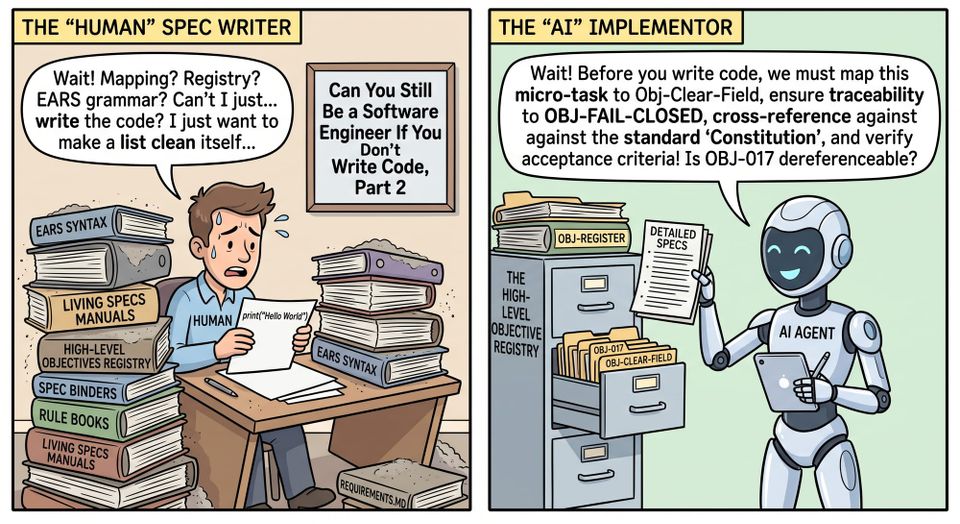
As we discussed in a previous post (available here), software specifications are the primary way to guide an AI agent that produces code in a new project.
Development has continued on the project “MyCobot 280 M5 Constrained Approach Planner, described in the post. Along the way, I have noticed that on occasion the agent will make mistakes that seem like they could have been avoided, and I was wondering if there is something I could add to the specifications to prevent such errors.
Included below (edited slightly for brevity) is a record of the discussion I had with the agent on this topic:
User (04:24)
This is just a general discussion topic—no project changes.
I find that the errors which are overlooked by the AI are those which would occur without a high-level view of the project's objectives. Even with detailed requirements, it seems that a higher-level functional requirement is needed by which the detailed requirements can be measured.
Would this help avoid errors where something is overlooked because it is missing from the detailed requirements, but is clearly needed to achieve the project's high-level objective?
Can the AI process requirements in a hierarchical manner?
Assistant
Yes, on both counts — and this matches how the failure mode actually arises. Let me unpack it.
Why detailed requirements alone fail. A detailed requirement list is always a lossy projection of the real objective. Whoever wrote it (human or AI) made judgment calls about what was "obvious enough" to leave out. A human implementer silently re-derives the missing pieces because they hold the objective in their head; an AI working strictly from the detail list has no basis for that re-derivation. The error you describe — something missing from the details but clearly needed for the goal — is precisely a case where the detail list underdetermines the objective and there's no stated objective to fall back on. Your own repo has a concrete example: the inter-episode target-clear bug. Every detailed step ("spawn episode N's targets", "remove episode N's target ids") was satisfied, but the higher-level invariant — each episode plans from a clear field — was violated because candidate ids were disjoint across episodes. Once that invariant was written down explicitly (it's now in .cursor/rules/35-isaac-smoke-physx-and-logs.mdc), the class of bug becomes checkable rather than inferable.
Can AI process requirements hierarchically? Yes, but only if the hierarchy is in context. Models don't have a persistent "project understanding" they carry between judgments; they reason over what's in front of them. So the practical answer is: the hierarchy must be an artifact, not an assumption. Three things make it work well:
- State objectives and invariants as first-class text, separately from procedures. "The suite must fail if any prohibited contact occurs" is an invariant; "subscribe to PhysX contact reports" is a mechanism. When both are present, the AI can notice when a proposed change satisfies the mechanism but breaks the invariant (e.g., a refactor that keeps the subscription but stops checking the result). When only the mechanism is stated, that check is impossible.
- Make detailed requirements traceable to their parent. A detail like "clear all prims under /World/Phase7_2/Targets" is much more robust when annotated with why ("so each episode plans from a clear field"). The "why" lets the AI generalize correctly when the situation shifts slightly — a new replay path, a new spawn mechanism — instead of applying the letter of the rule in a context where it no longer achieves the intent.
- Ask for the check explicitly. The most reliable pattern is to make objective-conformance a step, not a hope: "before finishing, verify the change against the invariants in spec section X" or acceptance criteria phrased as observable outcomes ("no episode starts with residual targets present") rather than implementation steps. AI is quite good at auditing a change against a stated invariant; it's much weaker at spontaneously recalling an unstated one.
The caveat. Hierarchy doesn't eliminate the problem, it moves it up a level. The high-level objective is itself a lossy statement of intent, and there will be cases where the details and the objective are both satisfied and the outcome is still wrong. But the error rate falls a lot, because most "overlooked" errors live exactly in the gap between mechanism and intent — and that gap is what the hierarchy fills. There's also a context-budget trade-off: a huge objectives document that's always attached dilutes attention. The pattern you've converged on in this repo is close to the sweet spot: a small set of always-applied invariants (fail-closed rules, "never weaken thresholds"), a spec.md consulted for architectural changes, and per-phase acceptance criteria. The one refinement I'd suggest is consistently writing each detailed requirement with its parent objective inline ("do X so that Y"), because that's the form that lets an AI catch the "X was done but Y still fails" cases — which is the exact class of error you're describing.
User (04:38)
I understand your point about the gap between intent and mechanism, and I agree with your point regarding the need to avoid diluting attention. Is there a way to create detailed requirements separately from the parent objective? In other words, "do X, reference objective Y"? Since the objectives will change less often and will be referenced repeatedly by each detailed requirement, this would be structurally more appealing.
Assistant
Yes — what you're describing is essentially requirements traceability with a normative objectives registry, and it's structurally sound. It's how safety-critical standards (DO-178C, ISO 26262) organize things: a small, stable set of high-level objectives with stable IDs, and every detailed requirement citing the ID of the objective it serves. It works well with AI too, with one important adaptation.
The structure. Keep a single registry — one page, not more — where each objective is a stable ID plus a one-to-two-line normative statement:
OBJ-CLEAR-FIELD:
Every episode's target field is planned from an empty /World/Phase7_2/Targets subtree; no residue survives across episodes or replay passes.
OBJ-FAIL-CLOSED:
Any prohibited body-target contact fails the episode; absence of contact evidence when contact occurred is itself a defect.
Detailed requirements then read "Before spawning episode targets, remove all prims under /World/Phase7_2/Targets [OBJ-CLEAR-FIELD]". The registry changes rarely; the details churn freely; the linkage survives the churn.
The adaptation AI needs: references must be dereferenceable at reasoning time. A human reads "[OBJ-CLEAR-FIELD]" and lazily looks it up if unsure. An AI can only benefit from the reference if the referenced text is actually in context when the judgment happens. So the registry must either be small enough to always attach (an always-applied rule is the natural home in Cursor — 35-isaac-smoke-physx-and-logs.mdc is already halfway to being this), or there must be a standing instruction to read the registry file before changing anything that cites an objective. If the ID resolves to text the model hasn't loaded, it degrades into an opaque token that gets pattern-matched past, and you lose the whole benefit.
Two refinements that make the reference scheme work harder for you:
- Make the IDs self-describing. OBJ-CLEAR-FIELD carries most of its meaning in the name; OBJ-017 carries none. A meaningful slug means that even when the registry isn't fully attended to, the reference itself still communicates intent. This is a cheap partial hedge against the dereferencing problem.
- You get reverse traceability for free, and it's the more powerful direction. Once details cite objectives, you can ask "list every requirement that serves OBJ-CLEAR-FIELD" and audit coverage: is the invariant enforced on the replay path? On the GUI path? That query is exactly how the target-field bug class gets caught before it happens — the objective was covered on the spawn path but nobody had written the citation for the --no-auto-exit replay path, and the gap would have been visible as a missing entry rather than a silent omission.
The one place I'd still deviate slightly from pure ID-references: when a detailed requirement's connection to its objective is non-obvious, keep a half-line gloss at the reference site ("remove all prims, not just next episode's ids — disjoint candidate ids leave residue [OBJ-CLEAR-FIELD]"). The ID gives you structure and stability; the gloss guards against the case where the link itself is the subtle part. Pure references are best where the connection is mechanical; hybrid where it's the insight.
So concretely for this repo, if you ever wanted to adopt it: a short docs/objectives.md (or a section at the top of spec.md) with slug IDs, referenced from phase reports and the smoke rules, with the registry itself attached as an always-applied rule. Small, stable, always in context — details cite it rather than restating it.
User (04:54)
One more thing:
Do you know of any articles on how to construct requirements documents for optimal AI interaction?
Assistant
Yes — this has become an active topic in the last couple of years under the name "spec-driven development" (SDD), and several of the pieces map directly onto what we discussed. Here's a reading list, roughly ordered by relevance to your article angle.
On writing specs for AI agents generally:
- How to write a good spec for AI agents — Addy Osmani (Google Chrome). Probably the best single starting point. Draws on a GitHub analysis of 2,500+ real agent instruction files. Notable findings: the most effective specs use a three-tier boundary system (always / ask-first / never) rather than flat do-and-don't lists, one real code snippet beats paragraphs of style prose, and "never commit secrets" was the single most helpful constraint in the study. Also covers splitting specs by component to avoid the attention-dilution problem you raised.
- Spec-Driven Development: The Definitive 2026 Guide — a survey of the whole methodology (specify → plan → task → implement, with GitHub's Spec Kit tooling). Directly relevant to our conversation: its concept of a "constitution" — a small, durable, always-attached project-rules document that every spec and agent action must respect — is precisely the objectives registry we sketched. Their practical guidance also echoes what we converged on: keep specs 1–3 pages, review at phase boundaries, treat specs as durable docs that outlive the code.
- Spec-Driven Development: From Code to Contract — the academic treatment (arXiv, 2026). Its "golden rule" is worth quoting for an article: use the minimum level of specification rigor that removes ambiguity for your context. It also formalizes the "what vs. how" separation — behavior-focused, testable, unambiguous — which is the mechanism/intent gap in different vocabulary.
On requirement syntax and hierarchy specifically:
- EARS, Fifteen Years On: The Requirements Format Built for the Agent Era — EARS (Easy Approach to Requirements Syntax) is a constrained grammar from Rolls-Royce jet-engine requirements work ("WHEN [trigger], the [system] SHALL [response]"), and it's having a revival because agents parse it reliably — each requirement collapses to a single testable claim with no floating conditions. Interesting origin story for an article: Mavin extracted the pattern from airworthiness regulations that mixed objectives and requirements at different levels in prose — the exact hierarchy-collapse problem you described.
- EARS Fundamentals (Specy) — shows the traceability side in tooling form: model elements declare satisfies references back to requirement IDs, and a checker flags any requirement with no satisfier. That's the reverse-traceability audit ("which requirements serve OBJ-X, and is any path uncovered?") from our discussion, mechanized.
- Living Specs for AI Agent Development — argues the spec must be bidirectional: implementation decisions flow back into the spec, otherwise regeneration from stale requirements causes drift. Your repo's practice of updating spec.md and phase reports in the same change set is this pattern.
One observation for your article: the industry is converging from two directions on the same structure. The AI-tooling world (Spec Kit, Kiro, AGENTS.md) arrived at constitution + spec + tasks by trial and error with agents; the safety-critical world (EARS, DO-178C-style traceability) had objectives + requirements + verification matrices for decades. The convergence point — a small stable objectives layer, atomic testable requirements citing it by ID, and mechanical coverage checks — is exactly the hierarchy you proposed, which suggests it's not incidental but forced by the same underlying problem: any implementer without persistent global context, human or machine, needs intent made into an artifact.

Comments ()