Was Erik J. Larson, author of the "The Myth of AI", right?
I periodically "clean" my bookshelf of old books to make room for new ones, generally trying to find them a new home in a public library or with an old friend. I know this might seem like literary heresy to my learned brain trust, but it does have the advantage of letting me look back to see how far I have come (or not).
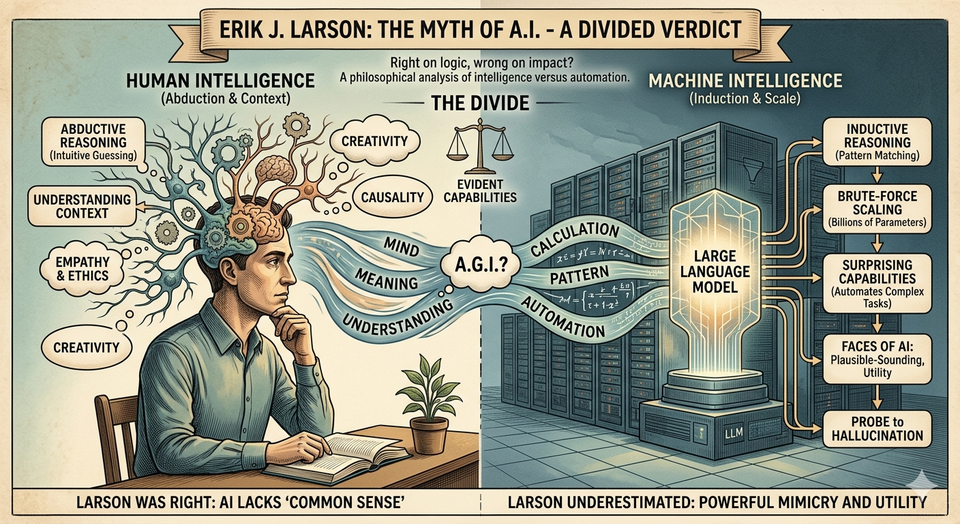
In my last cleaning, I came across Erik J. Larson’s book “The Myth of Artificial Intelligence”. I immediately checked the copyright and found that it was written in 2021, well before the breakthroughs enabled by the Transformer architecture in today’s LLMs. I read the introduction, and I could see where he was right and what he missed in his estimation of the future of AI.
I was curious if Larson had ever produced an article assessing the accuracy of his own book some five years later, an eternity in technology. I could not find such an article and, as I thought might write it, it occurred to me that an AI might be better suited to evaluate a book about itself. Here is an excerpt:
The Verdict
Larson wasn't wrong about the science; he was wrong about the threshold of what that science could achieve.
If your definition of AGI is a machine that possesses genuine understanding, consciousness, and human-like common sense, Larson is still correct. We are nowhere near that, and LLMs will likely never get us there because they are fundamentally just text predictors.
However, if your definition of AGI is a machine that can successfully automate almost any intellectual task a human can do, Larson underestimated the timeline. By dismissing "brute force scale," he didn't foresee that a massive statistical calculator could mimic human intelligence so effectively that, for most practical purposes, the distinction almost ceases to matter.
I find the last statement to be quite profound. Is it possible that, in the final analysis, human cognition is just a complex mix of emotional reinforcement combined with statistical models accumulated over many years of biological growth? Perhaps it is just the logical outcome of an organ seeking maximal adaptability, and that AIs will converge on a similar organ befitting their digital substrate.
Stay tuned!

Comments ()